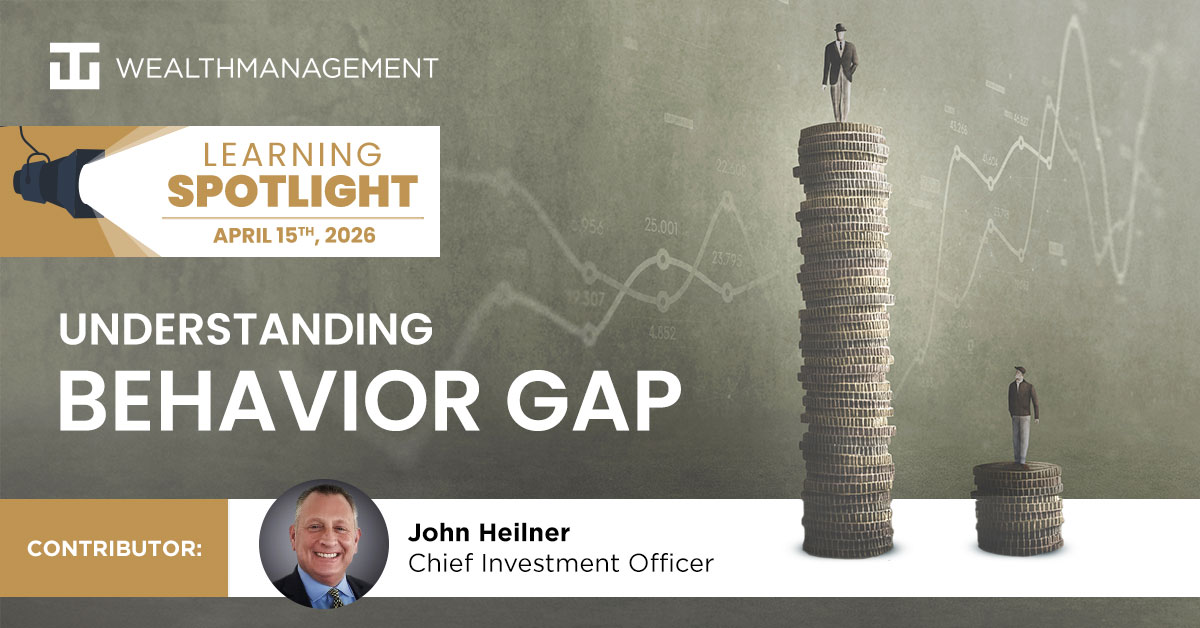
Understanding Behavior Gap - April 15th 2026 Learning Spotlight | WT Wealth Management

Today’s Learning Spotlight builds on our previous discussion that “volatility is the price of admission” for achieving the strong equity returns disciplined investors have enjoyed over the past decade. To put this into perspective, the S&P 500 has delivered an average annual return of approximately 15.5% since January 1, 2016; yet many investors have significantly underperformed the most widely followed benchmark. (1a)

Looking back at the tariff-fueled sell-off that started on April 3rd 2025, one of the most important lessons is the distinction between investment returns and investor returns. While the S&P 500 finished the year up an impressive 17.9%, many investors experienced very different outcomes. Those who reacted emotionally, selling at market lows, may have locked in double-digit losses and missed the swift rebound that began on April 9, 2025.

Panic selling is nothing new. In 2020, as a result of COVID-19, investors experienced even greater volatility than in 2025, with the S&P 500 falling more than 30% from mid-February to the end of March. Yet, investors who maintained their plan recovered those unrealized losses and saw the S&P 500 finish the year up 18.4%. (1b) We often say that markets can recover swiftly, but not every investor participates in that recovery.

Market timing, while appealing to risk-averse investors, is far more difficult than it appears. Attempting to exit before a downturn and re-enter once conditions improve requires not one, but two correct decisions. In practice, this becomes a complex, high-stakes challenge: knowing when to get out and when to get back in. Falling short on either decision, or often both, creates what we refer to as the “behavior gap,” the central theme of today’s Learning Spotlight.

Investment Return vs. Investor Return

When evaluating investments, many investors focus solely on published performance figures or historical track records of stocks, mutual funds, or Exchange Traded Funds (ETFs). However, what often goes unnoticed is that investment returns and investor returns are rarely the same.

The primary driver of investment gap is investor behavior

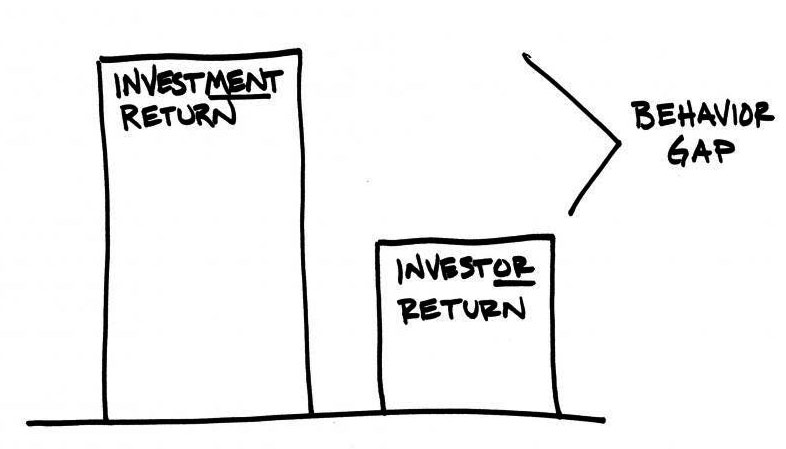
An investment’s return reflects the performance of that asset, assuming a buy-and-hold approach over a specific period. An investor’s return measures the actual results investors experience accounting for the timing of purchases, sales, and the emotional decision-making along the way. In many cases, investors significantly underperform the very investments they own.

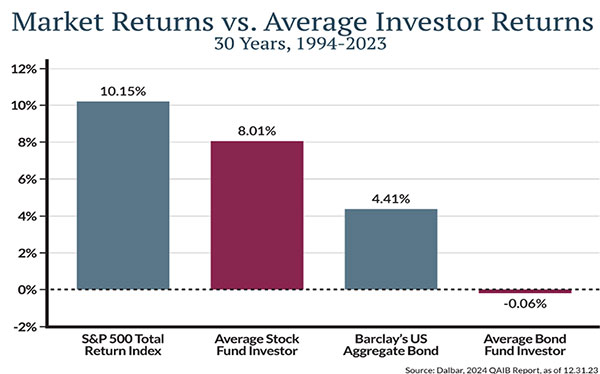
Research from DALBAR, which tracks investor behavior, consistently shows that the average equity fund investor underperforms the broader market by several percentage points annually. (2) The problem isn’t the actual investment; it’s the timing of decisions driven by investor emotions.


Market Returns vs Average Investor Returns


The Power of Discipline

The difference between investment returns and investor returns ultimately underscores the value of discipline. Staying invested through market cycles, maintaining perspective during volatility, and adhering to a long-term investment strategy will improve outcomes.

Working with a financial advisor can also improve outcomes

During unsettling periods of volatility is where a financial advisor contributes meaningful value. Beyond portfolio construction, advisors provide behavioral coaching; helping investors stay focused on strategy rather than headlines.

Conclusion

The performance of an investment and the performance of the investor are not the same. In fact, the “behavior gap” can be more damaging than choosing the wrong investment altogether.

Behavior Gap


Emotional reactions, poor timing, and performance-chasing widen the gap between what investments earn and what investors achieve.

Markets generate returns, but investor behavior determines results

When markets become challenging, the team at WT Wealth Management serves as both investment professionals and behavioral guides. By grounding decisions based on historical research our advisors help clients stay focused and “on plan” thus achieving better outcomes than those investors who attempt to navigate volatility alone.

WT Wealth Management Learning Spotlights are designed to inform, inspire, and encourage meaningful dialogue between our clients and advisory team. Our mission is to demystify complex economic and investment topics, translating financial theory into clear, practical insights that support better real-world decisions.


SOURCES
  1. ChatGPT
  2. Since 1994, DALBAR's Quantitative Analysis of Investor Behavior (QAIB) has measured the effects of investor decisions to buy, sell and switch into and out of mutual funds over short and long-term timeframes.
WARRANTIES & DISCLAIMERS

There are no warranties implied.
Any opinions expressed on this website are the opinions of WT Wealth Management and its associates only. Material listed on this website is neither an offer to buy or sell securities nor should it be interpreted as personal financial advice. You should always seek out the advice of a qualified investment professional before deciding to invest. Investing in stocks, bonds, mutual funds and ETF’s carry certain specific risks and part or all of your account value can be lost.

At WT Wealth Management we strongly suggest having a personal financial plan in place before making any investment decisions including understanding your personal risk tolerance and having clearly outlined investment objectives.

View Disclosure
WT Wealth Management is an SEC registered investment adviser, with in excess of $100 million in assets under management (AUM) with offices in Flagstaff, Scottsdale, Sedona and Tucson, AZ along with Jackson Hole, WY and Las Vegas, NV. WT Wealth Management is a manager of Separately Managed Accounts (SMAs). With SMAs, performance can vary widely from investor to investor as each portfolio is individually constructed and managed. Asset allocation weightings are determined based on a wide array of economic and market conditions the day the funds are invested. In an SMA, each investor may own individual Exchange Traded Funds (ETFs), individual equities or mutual funds. As the manager we have the freedom and flexibility to tailor the portfolio to address an individual investor's personal risk tolerance and investment objectives – thus making the account “separate” and distinct from all others we manage. An investment with WT Wealth Management is not insured or guaranteed by the Federal Deposit Insurance Corporation (FDIC) or any other government agency. Any opinions expressed are the opinions of WT Wealth Management and its associates only. Information offered is neither an offer to buy or sell securities nor should it be interpreted as personal financial advice. Always seek out the advice of a qualified investment professional before deciding to invest. Investing in stocks, bonds, mutual funds and ETFs carries certain specific risks and part or all of an account's value can be lost. In addition to the normal risks associated with investing, narrowly focused investments, investments in smaller companies, sector and/or thematic ETFs and investments in single countries typically exhibit higher volatility. International, Emerging Market and Frontier Market ETFs, mutual funds and individual securities may involve risk of capital loss from unfavorable fluctuations in currency values, from differences in generally accepted accounting principles or from economic or political instability that other nations experience. Individual bonds, bond mutual funds and bond ETFs will typically decrease in value as interest rates rise. A portion of a municipal bond fund's income may be subject to federal or state income taxes or the alternative minimum tax. Capital gains (short and long-term), if any, are subject to capital gains tax. Diversification and asset allocation may not protect against market risk or investment losses. At WT Wealth Management, we strongly suggest having a personal financial plan in place before making any investment decisions including understanding personal risk tolerance, having clearly outlined investment objectives and a clearly defined investment time horizon. WT Wealth Management may only transact business in those states in which it is registered, or qualifies for an exemption or exclusion from registration requirements. Individualized responses to persons that involve either the effecting of transactions in securities, or the rendering of personalized investment advice for compensation, will not be made without registration or exemption. WT Wealth Management's website is limited to the dissemination of general information pertaining to its advisory services, together with access to additional investment-related information, publications, and links. Accordingly, the publication of WT Wealth Management's website should not be construed by any consumer and/or prospective client as WT Wealth Management's solicitation to effect, or attempt to effect transactions in securities, or the rendering of personalized investment advice for compensation, over the internet. Any subsequent, direct communication by WT Wealth Management with a prospective client shall be conducted by a representative that is either registered or qualifies for an exemption or exclusion from registration in the state where the prospective client resides. A copy of WT Wealth Management's current written disclosure statement discussing WT Wealth Management's registrations, business operations, services, and fees is available at the SEC's investment adviser public information website (www. adviserinfo.sec.gov) or from WT Wealth Management directly. WT Wealth Management does not make any representations or warranties as to the accuracy, timeliness, suitability, completeness, or relevance of any information prepared by any unaffiliated third party, whether linked to WT Wealth Management's web site or incorporated therein, and takes no responsibility therefor. All such information is provided solely for convenience purposes and all users thereof should be guided accordingly.

Contact Us Today

Reach us directly at 800-825-0616
or by using the contact form below.

Your message has been sent. Thank you!
By checking this box, I consent to receive text messages related to my financial accounts and appointments from WT Wealth Management. You can reply STOP to opt-out at any time. Messages and data rates may apply. Message frequency will vary. Reply HELP for assistance. For more information refer to our Privacy Policy and SMS Terms and Conditions on our website.>
Cancel