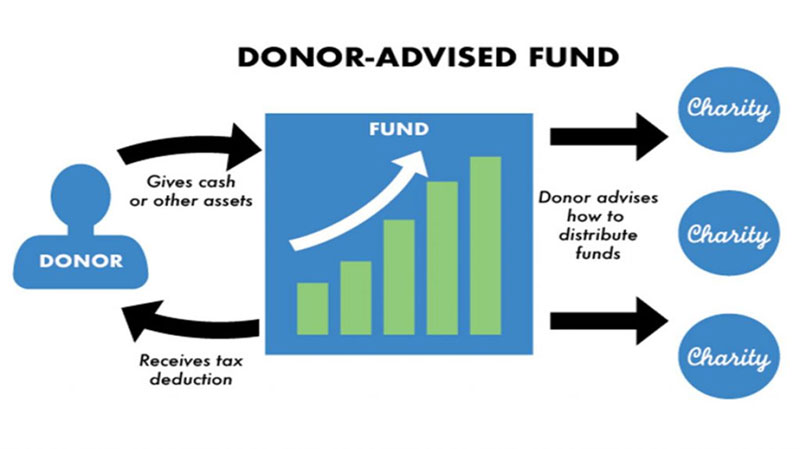
Charitable giving has always played an important role in wealth planning, and in recent years Donor-Advised Funds (DAFs) have become one of the fastest-growing Philanthropic vehicles for families who want to give strategically while leaving a generational legacy.
A donor-advised fund is a charitable investment account that allows individuals to contribute cash, appreciated securities, or other assets to a sponsoring public charity, receive an immediate tax deduction, and then recommend grants to their favorite charities over time.
Flexibility is what has made Donor Advised Funds attractive
At their core, DAFs separate the act of donating from the act of granting. You can contribute donations into a DAF in a year when it makes sense for your tax situation but distribute those funds to charities at any pace you wish, even years or decades later. Even small donors can create a multi-decade family legacy.
How Donor-Advised Funds Work
The process begins when a donor contributes assets into the DAF. This can include cash, publicly traded securities (highly appreciated make the most sense), private company stock, and even alternative assets. The sponsoring organization takes ownership of those assets, but the donor retains advisory privileges, meaning they can recommend which charities ultimately receive grants. While the contribution is irrevocable, donors can decide the timing, amounts, and recipients of the eventual grants.
Contributions to a DAF are eligible for an immediate charitable tax deduction in the year the assets are donated, subject to IRS rules and limits. For donors experiencing a windfall, selling a business, incurring large capital gains or facing a high-income year, a DAF can help capture the tax benefits now while buying time to decide which causes to support.
In addition, assets within a DAF can be invested for growth. Many sponsoring organizations like Charles Schwab offer a menu of investment pools ranging from conservative fixed-income funds to equity-focused portfolios. This investment feature allows the contributed assets to potentially appreciate, creating the opportunity for even greater charitable impact over time.
Advantages of Donor-Advised Funds
The most often cited advantage of a DAF contribution is tax efficiency. For instance, a donor contributing $50,000 of appreciated Google stock with a $10,000 cost basis is entitled to a $50,000 charitable income tax deduction (subject to AGI limitations), while simultaneously avoiding recognition of $40,000 in long-term capital gains. This dual benefit maximizes the after-tax value of the contribution and increases the funds available for charitable purposes.
DAFs also simplify record-keeping. Instead of managing receipts from multiple charities, a donor has one consolidated record from the sponsoring organization. For families, DAFs can serve as a practical tool to instill philanthropic values, allowing multiple generations to participate in decisions about which causes to support.
Considerations and Limitations
Despite their benefits, donor-advised funds are not without drawbacks. Once assets are contributed, they are irrevocably committed to charity, there is no way to retrieve them.
Charles Schwab has nearly 3,000 eligible A 501(c)(3)’s on their donor advised platform
Additionally, donors can only recommend grants; the sponsoring organization must approve them, although in practice nearly all recommendations are honored.
Conclusion
Donor-advised funds have become a powerful tool in modern philanthropy, offering tax efficiency, flexibility, and simplicity. For investors who want to maximize the impact of their charitable giving while integrating it with their broader financial plan, a DAF can be an excellent solution.
As with all tax & financial strategies, it’s wise to consult with your financial advisor and tax preparer to determine whether a DAF aligns with your long-term goals.
The WT Wealth Management Learning Spotlights are designed to inform, inspire, and foster meaningful dialogue between our clients and the WT Wealth Management team. Our goal is to demystify complex economic and investment topics, offering clear, practical insights that connect financial theory to real-world decisions.
 Home
Home