Although the stock market (for this purpose, the S&P 500) and the economy are often spoken about as if they move in lockstep, they are fundamentally different systems that measure distinct aspects of economic life. Their divergence becomes clear during periods when stock market rises amid economic hardship or falls despite strong economic data.
Stock prices are driven not only by current corporate performance but also by expectations or sentiment about the future. Equity markets are forward looking, often more concerned about next quarter than the reality on the ground today. A market rally may signal optimism about future growth rather than immediate quality of life improvements in employment, wages, or living standards.
The stock market represents the value investors assign
to publicly traded companies
By contrast, the economy encompasses the full range of real-world economic activity: jobs, consumer spending, manufacturing, small-business health, wages, and inflation. It includes every household and enterprise, not just publicly traded corporations. Many vital parts of the economy, such as small businesses, public services, and government institutions, do not issue stock, yet they play a central role in people’s economic well-being.
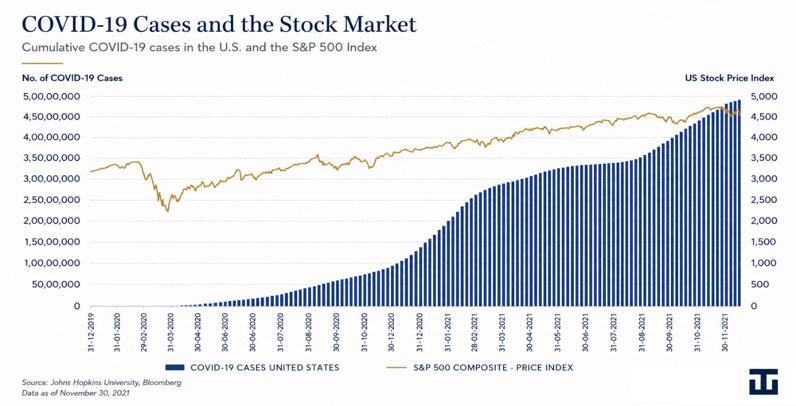
History offers many examples in which strong stock market performance has coexisted with stagnant wages, elevated unemployment, or sluggish economic growth. The periods following the 2008 global financial crisis and the 2020 COVID-19 recession highlight how stark this disconnect can be. In both cases, millions of people faced job losses and financial insecurity even as major stock indices rebounded quickly. Low interest rates and government stimulus disproportionately benefited large, publicly traded companies, allowing markets to recover while large segments of the broader economy continued to struggle.
The chart below shows the recovery of the S&P 500 against the spike in confirmed covid cases.
Conversely, a declining stock market does not automatically signal economic collapse. Markets can fall for reasons such as geopolitical tensions, shifts in interest rates, or changes in investor sentiment. In many cases, these factors may have little immediate impact on employment levels or consumer spending.
The stock market and the economy measure different sentiments
Ultimately, the stock market reflects investor expectations about the future, while the economy reflects present-day reality. Treating the stock market and the economy as one allows an investor the risk of misunderstanding both. The stock market represents only a “narrow slice” of economic activity; namely, publicly traded companies.
How narrow is the publicly traded slice? Recent data from Standard & Poor’s, shows the number of publicly listed companies in the United States has declined significantly over the past two decades. As of early 2024, fewer than 4,000 large companies remain publicly traded, down from nearly 10,000 in 2004.
(1)
By contrast, a research brief from the Cato Institute estimates that there are more than 25 million private companies in the United States. This disparity underscores that most U.S. businesses, and much of the economic activity that affects everyday life, exist beyond the public markets.
(2)
Recognizing the distinction between the stock market
and the economy is essential
Recognizing that the stock market reflects investor expectations, not the lived experiences of most Americans, allows for a clearer, more realistic assessment of economic conditions. By separating these concepts, investors gain a more accurate understanding of where prosperity exists, where it’s absent, and which policies are needed to develop broad, sustainable economic growth.
WT Wealth Management Learning Spotlights are designed to inform, inspire, and foster meaningful dialogue between our clients and our team. Our aim is to demystify complex economic and investment topics while offering clear, practical insights that can support confident decision-making.
SOURCES
- https://www.thecorporatecounsel.net/blog/2025/09/the-decline-of-public-companies-stats-from-the-sec.html
- https://www.cato.org/research-briefs-economic-policy/where-wild-things-are-governance-private-companies
 Home
Home