One recurring theme during every election cycle is the relationship between unified and divided government, whether one political party controls the presidency, House of Representatives, and Senate, or whether control is shared between the parties, and how those political structures have historically influenced stock market performance.
With the midterm elections under one month away, understanding how political dynamics influence financial markets is a key element of investor awareness. This learning spotlight will showcase S&P 500 results during periods of unified and divided government.
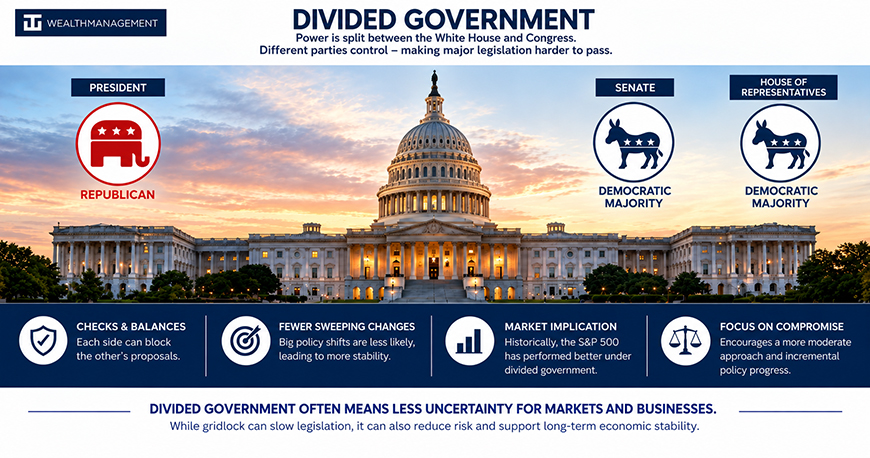
History suggests that financial markets have often responded more favorably to periods of divided government than to periods of unified political control. A divided government typically results in legislative gridlock, making it more difficult to enact sweeping or unexpected policy changes.
While gridlock may be viewed as a frustration from a governing perspective, investors have often welcomed the policy stability it can create. Businesses and markets generally prefer a predictable operating environment, where long-term decisions can be made with greater confidence.
Investors prefer investing under a familiar set of rules
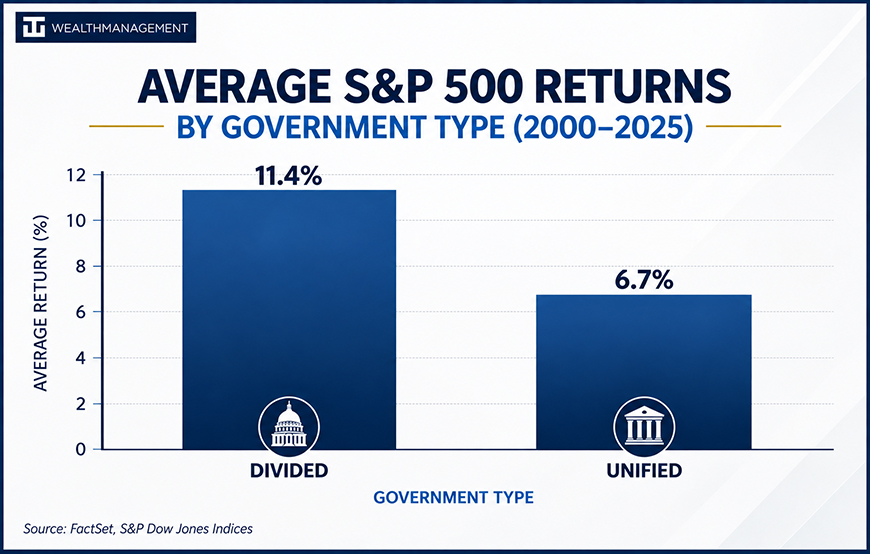
Data over several decades suggests that the S&P 500 has often outperformed during periods of divided government when compared to periods of unified government. The bar-chart below suggests a 4.7% average annual performance gap between periods of unified and divided government on capitol hill.
(1)
Periods following U.S. midterm elections, when divided government frequently emerges, have historically been associated with strong equity market performance. One possible explanation is that investors often view a reduced likelihood of sweeping legislative changes as a source of policy stability. Greater predictability can improve business confidence, reduce uncertainty, and create a more favorable environment for equity valuations.
By contrast, a unified government gives one political party greater ability to advance its legislative agenda. While this can result in faster and more decisive policymaking, it may also introduce greater market uncertainty as investors evaluate the potential impact of significant tax, regulatory, spending, or trade policy changes. The market's reaction ultimately depends less on which party is in power and more on how proposed policies affect economic growth, corporate earnings, inflation, and investor confidence.
Divided government often generates compromise
When the probability of sweeping policy changes declines, market uncertainty often declines with it. Greater policy stability can improve business confidence and provide a more favorable backdrop for equity markets. However, investors should avoid attributing market performance solely to Washington. Political structure is only one piece of the puzzle no single political structure guarantees positive market returns. Over the long term, factors such as economic growth, inflation, interest rates, corporate profitability, and innovation have consistently played a much larger role in determining stock market returns.
The WT Wealth Management Learning Spotlights are designed to educate, inform, inspire, demystify and foster meaningful dialogue between our clients and the WT Wealth Management team. Our goal is to simplify complex economic and investment topics, offering clear, practical insights that connect financial opportunities to your portfolio.
- Note: Year-by-year S&P 500 returns (2000–2025), each year classified as unified government (President + Congress same party) and divided government. The general finding is consistent across multiple analyses via ChatGPT. Post-2010 pattern is clearer. From ~2011 onward: Divided government years (2011–2016, 2019–2020, 2023–2025) → Generally strong, consistent returns. Unified periods (2017–2018, 2021–2022) → more volatile (big up years + sharp drawdowns). This supports the core thesis: Markets tend to reward policy stability more than policy control
 Home
Home